Ekiti State Electricity Priority Plan and Implementation Roadmap (SEPP-IR) and six lessons other states can act on
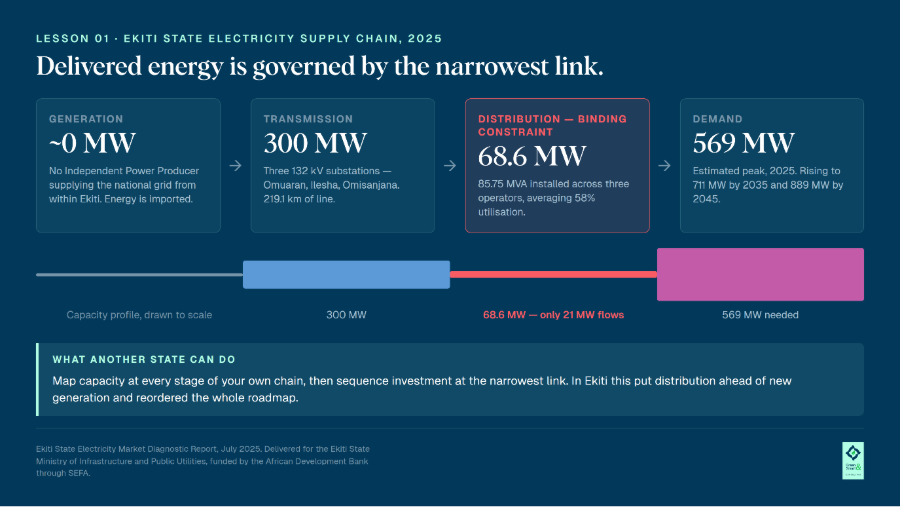
Ekiti’s electricity supply chain as found. Distribution — not generation — was the binding constraint.
The situation
In October 2023, Ekiti State enacted the Ekiti State Electric Power Sector Law 2023 (EKEPSL 2023), Law No. 11 of 2023. Seven months later, on 1 May 2024, the newly created Ekiti State Electricity Regulatory Bureau (EKSERB) formally assumed regulatory authority from the Nigerian Electricity Regulatory Commission (NERC).
Ekiti had a law, a regulator, and jurisdiction over its own electricity market. What it did not yet have was a functioning market, and it was clear-eyed enough to say so and commission the work to find out precisely why.
That decision is itself the first thing worth copying. The Electricity Act 2023 devolved electricity regulation to Nigeria’s states. Enacting a state law is the straightforward part, and many states have now done it. Building a market that investors will actually finance is a different order of problem, and no state can sequence that work without first knowing what it has.
Ekiti chose to measure before it built. This case study sets out what that measurement found, what our team learnt from it, and what any other state can take from the experience.
What we did
The assignment ran in two stages, producing two documents designed to be read together.
Stage one — Diagnostic
We assessed the legal, institutional, infrastructure and market realities of electricity in Ekiti State, drawing on consumption data from the major distribution companies serving the state – BEDC Electricity Ekiti Limited (BEEL) and Ekiti Electricity Distribution Company Limited (EEDCL), geospatial datasets from the Rural Electrification Agency (REA), state budget and asset records, and stakeholder consultations across the public sector, private operators and communities.
The diagnostic benchmarked EKEPSL 2023 against what a functioning electricity market legally requires, and set out the gaps candidly. Ekiti’s willingness to have that done, and to publish the result, is what made the roadmap that followed worth anything.
Stage two — Priority Plan and Implementation Roadmap
The SEPP-IR converted every diagnostic finding into an executable instrument, across six linked sections.
Business models. Five franchise-ready structures covering the value chain — Independent Power Producers (IPPs), Mini-Grid Operators, Energy Service Companies (ESCOs), an Integrated Transmission and Distribution (T&D) Franchise with open access, and Cluster Offtake Units (COUs). Each modelled through a Business Model Canvas with value proposition, partnerships, revenue streams and risk allocation, and each sequenced against a phase of market maturity.
A regulator that works. A complete business plan and operational manual for EKSERB: organisational structure, staffing plan, licensing and enforcement functions, priority regulatory instruments with timelines, five-year revenue and expenditure projections, and a funding path that moves the bureau off state subvention and onto statutory fees.
A workforce. A sustainable capacity-building framework, including the proposed Ekiti State Electricity Training and Capacity Development Institute (ESET-CDI), partnerships with the National Power Training Institute of Nigeria (NAPTIN), technical and vocational education and training (TVET) institutions and state universities, and gender and social inclusion targets carried through to delivery.
A pipeline. Nine bankable renewable energy projects totalling approximately 363 MW and USD 353 million, from the 193 MW Ekiti East Solar Park down to a ten-site rural mini-grid cluster each with capacity, location, investment size, delivery duration, named government counterpart, current stage and a bankability profile matching it to specific financing sources.
A policy toolkit. Identified policy gaps, strategic recommendations benchmarked against global regulatory practice, and the support instruments needed to implement them.
A roadmap. Everything above consolidated into a phased 2025–2030 matrix of activities, responsible agencies, timelines, budgets and expected outcomes, with a monitoring and evaluation framework tied to service quality, access and financial performance.
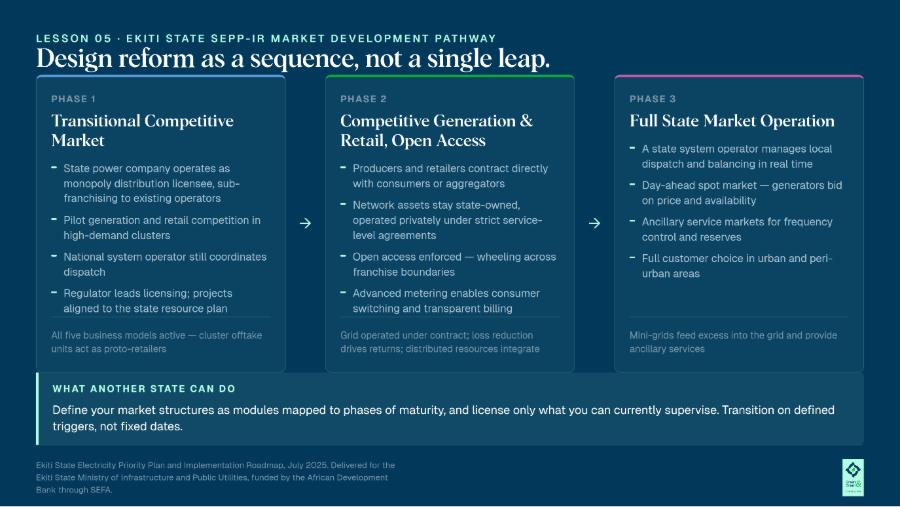
The market development pathway designed for Ekiti — three phases, each with its own enabling business models.
Six lessons, and what other states can do with them
Each lesson below follows the same shape: what the evidence showed in Ekiti, what our team took from it, and the specific action another state can implement.
Lesson 1 — Find the binding constraint before financing anything
What the evidence showed. In 2025, Ekiti had 300 MVA (megavolt-amperes) of installed transmission transformer capacity across three 132 kV substations, and 85.75 MVA of distribution capacity — about 68 MW. It received 21 MWh/h on average from the grid in 2025 having an estimated peak demand is 569 MW.
What we learnt. Delivered energy is governed by the smallest link in the chain, not the largest. Generation is the visible, announceable part of a power system. Distribution is buried, unglamorous, and decisive. Had 200 MW of new generation been built first, delivered energy would have moved very little — the distribution network could not have carried it.
What another state can do. Before committing to any generation programme, map capacity at every stage, generation, transmission, distribution, delivered on a single chart. Identify the narrowest link and sequence investment there first. In Ekiti this reordered the entire roadmap, putting distribution capacity ahead of new generation. The analysis takes weeks and can redirect hundreds of millions of dollars.
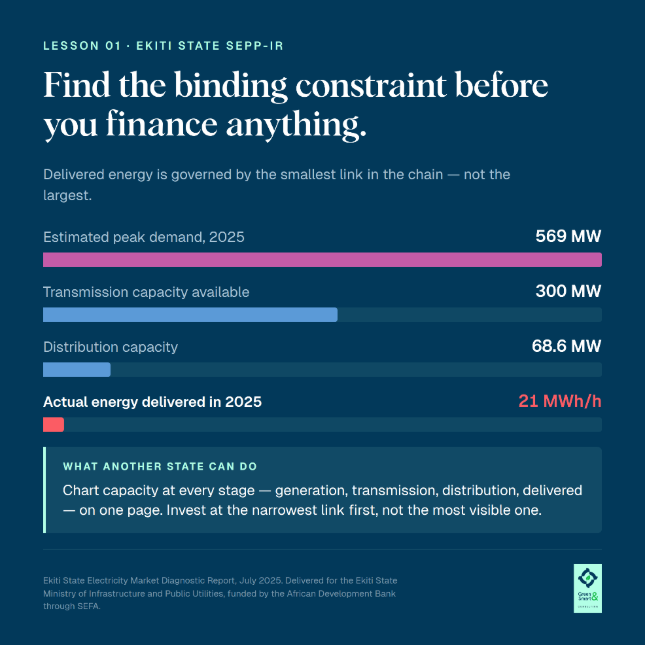
Peak demand against each stage of the supply chain.
Lesson 2 — Metering is the precondition for finance, not a service upgrade
What the evidence showed. As of March 2025, 22% of consumers were metered, with 87,720 unmetered customers. Industrial metering stood at 3%, commercial at 8%. Estimated losses from unmetered consumption exceeded ₦255 million per month, and state-wide collection efficiency averaged just over 53%.
What we learnt. The highest-consuming segment – industrial and commercial – was the least metered. No investor commits capital to a distribution business whose revenue line is an estimate, so metering is not a quality-of-service refinement to schedule for a later phase. It is the condition on which every other reform becomes financeable.
What another state can do. Establish metering penetration by customer class, not just in aggregate, and treat closing the commercial and industrial gap as a first-phase priority. Ekiti’s regulator made its very first regulatory order a mandate for distribution companies to meter their customers, a low-cost, high-signal move any new state regulator can replicate in its opening months.
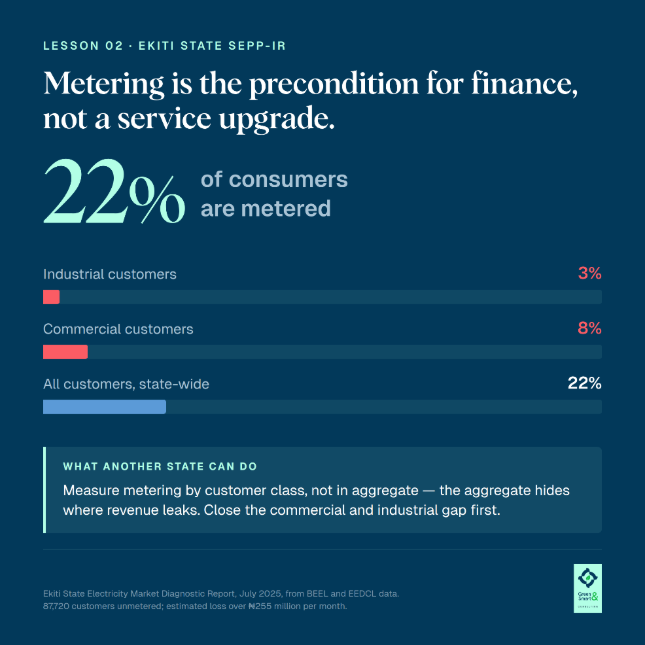
Metering penetration by customer type, March 2025.
Lesson 3 — Cost-reflective and affordable are not the same thing
What the evidence showed. At ₦220/kWh, a household consuming 150 kWh per month spends roughly ₦33,000, about a third of estimated average household income. Global affordability thresholds sit between 5% and 10%.
What we learnt. A tariff that is cost-reflective and unaffordable does not produce revenue. It produces non-payment, bypass and theft, which is precisely what a 53% collection efficiency reflects. Tariff reform designed without an affordability analysis will underperform its own projections.
What another state can do. Run an affordability analysis against household income data before setting tariff policy, not after. Where the gap is wide, pair cost-reflective pricing with lifeline tariffs, means-tested support, progressive tariff structuring, and demand-side efficiency that reduces the kilowatt-hours a household needs. And link electrification planning to income generation. Subsidy cannot close an affordability gap indefinitely, but rising household income can.
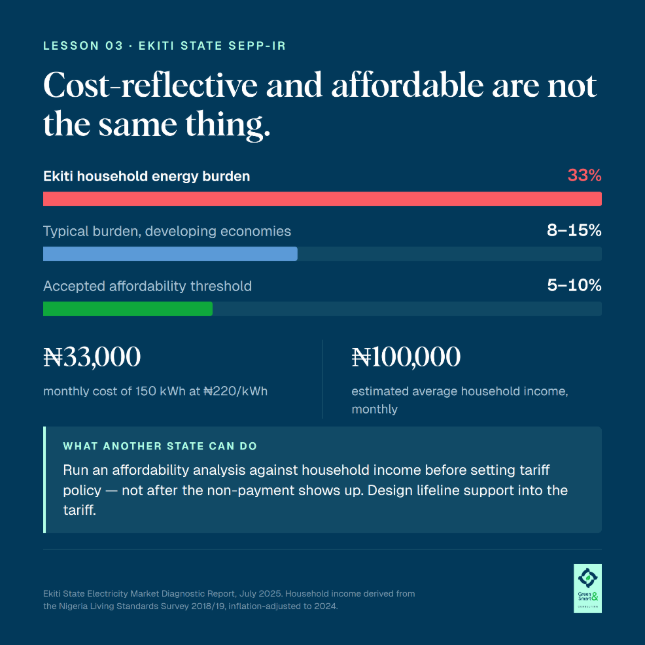
Household energy burden against accepted affordability benchmarks.
Lesson 4 — Resource potential is not a project pipeline
What the evidence showed. Ekiti holds an estimated 5,437 MW of renewable potential: 338 MW solar across two identified sites, 270 MW hydro largely from existing water-supply dams, and 4,829 MW of biomass from agricultural and wood-processing waste. As at 2025, Installed renewable generation was zero.
What we learnt. Resource potential is a geological and agricultural fact. A pipeline is a financial and institutional artefact. Nothing converts one into the other automatically, and a resource assessment on its own gives an investor nothing to act on.
What another state can do. Convert the resource number into projects a financier can read: identified sites, sized capacity, costed investment, delivery duration, named government counterpart, current stage, and a bankability profile matched to specific funders. Ekiti’s nine projects are each mapped to real financing routes — the Green Climate Fund, InfraCredit Nigeria, the Nigerian Sovereign Investment Authority (NSIA), the Economic Community of West African States (ECOWAS) Renewable Energy Facility, the Clean Technology Fund, World Bank and AfDB instruments. That mapping is what turns a statistic into a transaction.
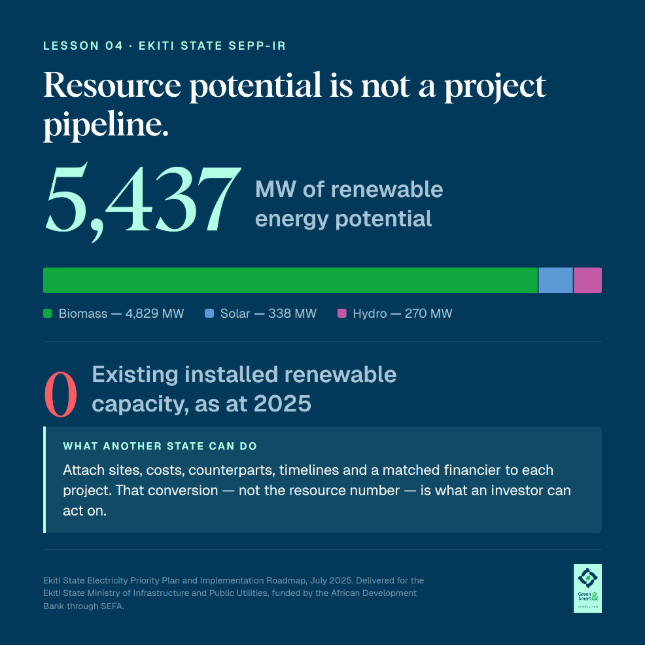
Renewable resource potential against installed capacity.
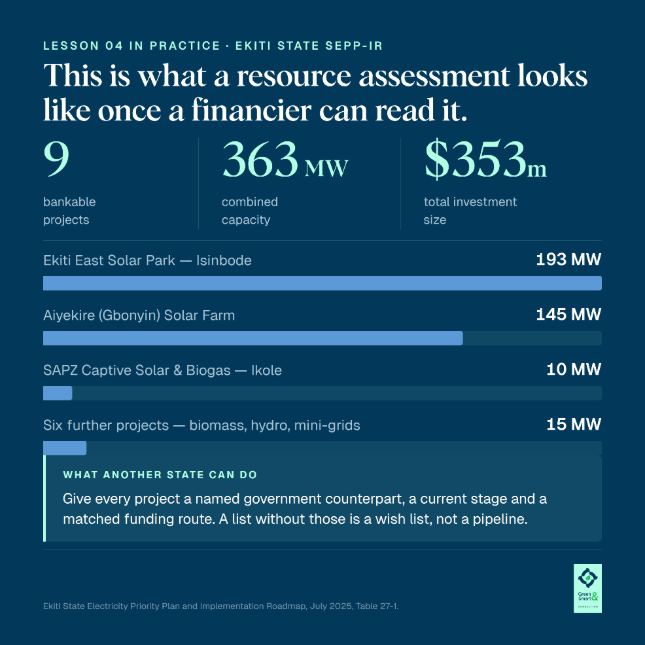
The nine bankable projects the resource assessment was converted into.
Lesson 5 — Regulatory independence is financed, not declared
What the evidence showed. By the time of assessment, EKSERB had issued 15 interim licences across distribution, generation, mini-grid and metering, and released three regulatory orders, operating from temporary premises and supported by a seconded legal officer. Its enabling law required it to seek approval for regulatory activities and allowed the executive to assign it tasks, and provided no clear funding mechanism.
What we learnt. A capable, willing regulator can still lack the autonomy investors price for. Independence is a budget line and a set of statutory powers, not a clause of intent and investors read the statute, not the press release.
What another state can do. Give the regulator an operational business plan early: organisational structure, staffing, licensing and enforcement functions, priority regulatory instruments with dates, and multi-year revenue and expenditure projections. Most importantly, define the transition from state subvention to market-based funding through statutory fees, with milestones. Ekiti’s roadmap targets financial independence for EKSERB by 2029, at ₦2.065 billion in revenue.
Lesson 6 — The electrification pathway is a local-government question
What the evidence showed. Analysing 158 off-grid site observations across all Ekiti Local Government Areas (LGAs) against population, building density, distance to grid, institutional presence and agricultural activity produced three distinct answers: solar home systems for remote low-demand areas, mini-grids for unserved clusters with productive-use potential, and grid extension where lines are close and demand indicators are strong.
What we learnt. One state, three answers. A uniform electrification programme applied across a whole state will strand capital in some LGAs and under-serve others.
What another state can do. Score every LGA or every candidate site on population without access, distance to the nearest distribution line, institutional presence (schools and health facilities), and productive-use potential, then assign a pathway per LGA before procurement begins. The data required is largely already held by the Rural Electrification Agency. Tools that can be leveraged include the IRENA West Africa Electrification Platform and other electrification planning tools promoted by Energy Modelling Platform for Africa.
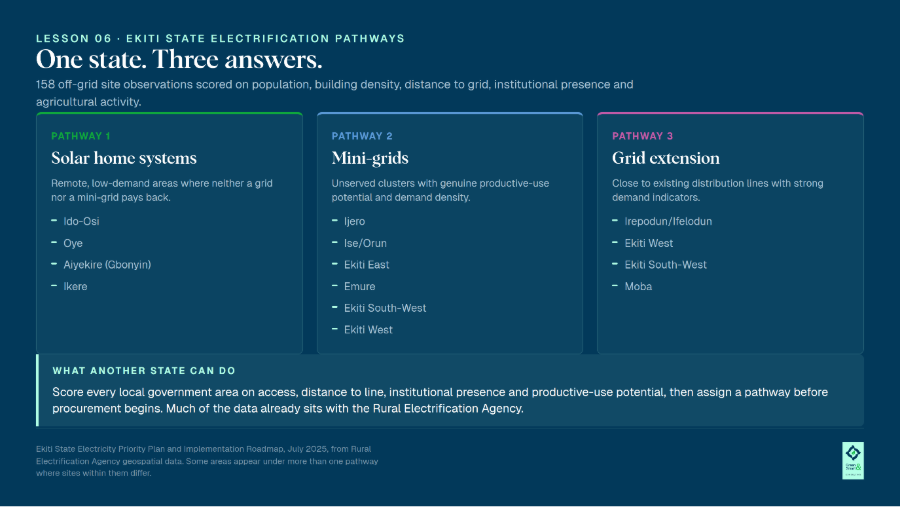
The three electrification pathways and the LGAs assigned to each.
A checklist for the next state
Everything above, reduced to what a state government can act on:
- Measure before you build. Commission a diagnostic that benchmarks your electricity law against what a functioning market legally requires, and publish the result.
- Chart capacity at every stage of the chain and sequence investment at the narrowest link, not the most visible one.
- Establish metering penetration by customer class and close the commercial and industrial gap first.
- Run an affordability analysis against household income before setting tariff policy.
- Convert your resource assessment into costed, counterpart-named projects matched to specific financiers.
- Fund your regulator through statutory fees on a defined timetable, and write the milestones down.
- Assign an electrification pathway per local government area before procurement begins.
- Sequence honestly. A roadmap credible in year five is worth more than one exciting in year one.
Why It Mattered
Ekiti now holds a costed, sequenced, institutionally grounded plan for the period to 2030: a regulator with a business plan and a route to autonomy, five franchise structures ready to license against, a project pipeline packaged for the AfDB, the Green Climate Fund, NSIA, InfraCredit Nigeria and blended-finance investors, and a monitoring framework that will show whether any of it is working.
The reports were validated through state-led stakeholder workshops and published under the authority of the Ekiti State Government. That openness is what allows other states to learn from the work rather than repeat it — and it is the reason this case study can be written at all.
Capabilities demonstrated
- Electricity market design and regulatory institutional development
- Power sector diagnostics and demand–supply modelling
- Renewable resource assessment and project pipeline structuring
- Bankability analysis and blended-finance packaging
- Geospatial electrification planning
- Policy and legislative gap analysis
- Capacity-building framework design
- Gender and social inclusion integration
- Multilateral-standard reporting and stakeholder validation
Green & Smart Consulting Limited — energy market development, regulatory advisory, and infrastructure project preparation.